The cork oak - Portugal's magical tree
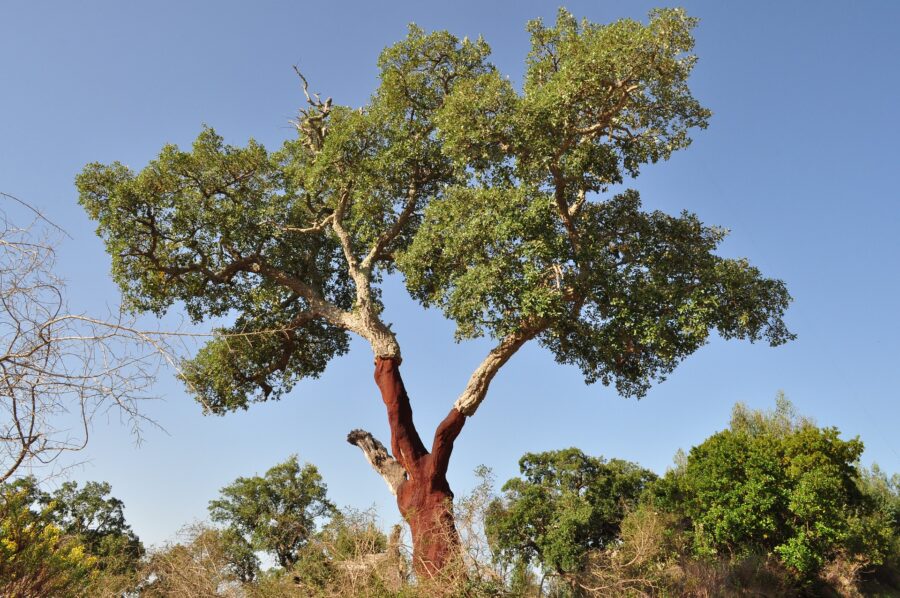
Have you ever thought about where the stopper of your bottle of wine comes from? The cork that comes from the cork oak that is. Nowadays, however, it is fairly common to get a bottle of wine with a plastic stopper which might be a bit surprising given the environmentally conscious times we are living in. Â In the mid-1990s there was some suspicion about the cork stoppers being of low quality affecting the wine negatively and many wine producers started to use plastic or aluminum stoppers instead. Now, luckily, some of them are switching back again, partly because of the environmental aspect and partly because of the breathing quality of the natural cork which some believe is good for the wine.
Cork from Portugal and Spain
Cork is, in fact, a very versatile and environmentally friendly material. About half of the world’s cork comes from Portugal, some from Spain and the rest from Northern Africa. The cork comes from the cork oak which is considered to be Portugal’s national tree, protected by strict laws. The laws make it illegal to cut down any cork oak in Portugal without special permission. The restrictions have also resulted in thousands of miles of cork forest, mainly in the region of Alentejo and there is a growth rate for the cork oak forests in Portugal of about 4 per cent per year. There is enough cork today in the forests of Portugal to last more than 100 years, should the consumption stay the same.
Thousands of cork oaks
The cork forests are located mainly in the Alentejo region. The picturesque region is occupying nearly a third of the mainland and is an hour’s drive from Lisbon. It is bound to the north by the river Tejo, and by mountains to the south. Spain and the River Guadiana mark the border to the east, and the Atlantic Ocean is the border to the west. The northeast of Cork Country is famous for its charming villages: Nisa, Castelo de Vide, Marvao, Portalegre and Alter do Chao. Further south, the landscape becomes warmer and flatter. Around Evora (one of the most beautiful cities in Europe), one finds the enchanting walled towns of Monsaraz, Vila Viçosa, Estremoz, and Arraiolos (renowned for its handmade tapestries and rugs). The cork oak (Quercus suber) is the only tree that regenerates its bark. It should not be confused with the “cork trees” (Phellodendron). They also have corky bark but are not used for cork production.
Cork harvesting
To produce cork, a cork oak must be at least 25 years old. A cork oak can live more than two centuries. In the Portuguese town of Aguas de Moura, there is a cork oak turning 235 years this year. It is referred to by many names, like Sobreiro Monumental (Monumental Cork Oak) or the Whistler tree after all the birds singing in its crown. Sometimes, it is also called the Matchmaker as there are many, many lovers who have sat in its shade. And many couples have got married next to it. Since 1998 the tree has been considered a National Monument, and the Guinness Book of Records states it as the largest and oldest cork oak in the world. The most widespread application in the history of cork is as a wine stopper. That usage began in the 17th century when Dom Perignon chose the bark of the cork oak as the perfect sealant for his champagne. Later it grew with the spread of mass-produced glass bottles.
Stripping the oak of its bark
It takes twenty-five years for the cork oak to grow large enough for the first stripping of the bark by a highly skilled cutter or extractor, a tirador. He peels away large cuttings using a specifically purposed hand-axe. He traditionally makes two types of cuts on the tree. One horizontal cut around the plant called a crown or necklace. That cut is made at a height of about 2 or 3 times the circumference of the tree, and several vertical cuts called rulers or openings. This is the most delicate phase of the work. The extractor must not damage the inner layer of bark or the tree will be harmed when cutting off the outer layer. Cork is extracted only from early May to late August. That is when the cork can be separated from the tree without causing permanent damage. The virgin cork (the first time a tree is stripped of its bark) has an irregular structure and is very rough and brittle. Therefore its main use is as wall and flooring insulation.
Every nine years
After a period of 9 years or more, when the outer bark has regenerated, a second cutting takes place. That one yields a denser bark but it still not good enough for bottle stoppers. The third cutting, that occurs any time after the tree is 43 years old, is what gives that high-quality cork. That cork is compressed and pliable and suitable for wine stoppers. It is easy to understand the Portuguese saying, “Plant a cork oak for your grandchildren”. Cork can be used as a material for many different things, not just as bottle stoppers. And the cork products, for example, the stoppers, can be recycled and used as a material in other things. Depending on the quality, cork can be used as insulation material, in handbags and wallets and other fashion items. It can be used in shoes, in musical instruments and as bricks for the outer walls of houses. In 2007, the Portuguese national postal service issued the world’s first postage stamp made of cork. It is used as the core of baseballs and cricket balls, and as part of heat shields in spacecrafts. It can be used as components in watches and to make wrist bands and for many other things. The possibilities are endless for this environmentally friendly and versatile material. And apart from cork being a useful material, the cork oaks are beautiful just as they are. They make up wonderful forests perfect for hiking. There are many companies in the areas that offer different types of guided hikes. The forests are also an important habitat for birds and other wildlife.