If you’re ever bored with swimming in the sea, why not take a closer look at these four beautiful Iberian lakes? The sun, sea and beaches attract millions of visitors to Spain and Portugal each year, but the countryside also has a lot to offer.

Lovely dual lake in Azores
The Lagoon of the Seven Cities
The first lake, which we find in Portugal, is called Lagoa das Sete Cidades or The Lagoon of the Seven Cities. It is a twin lake situated in the crater of a dormant volcano, in the archipelago of the Azores. It is the largest body of water in the region and one of the most important freshwater resources in the archipelago. Legend has it that a grumpy widower King and his daughter, the Princess, lived in a Kingdom in the Western Sea.
 Portuguese Lake
The King was very protective of his daughter and wouldn’t let her out of his sight. She grew up to be a very beautiful princess giving her father all the more reason to restrict her freedom. However, having a will of her own, she used to sneak out while her father took a nap after lunch and she would escape to the hills and valleys nearby. One day she heard beautiful music and she followed the enchanting tones. She found a young shepherd playing the flute sitting on a hill.
For weeks she would go and listen to the shepherd playing until one day he discovered her hiding behind some bushes. They fell in love and continued to meet in secret, enjoying each other’s company. The boy decided he wanted to ask the King for the Princess’ hand in marriage. He mustered up all his courage and knocked on the door to the palace. The King was furious when he heard of the young couple’s plans and sent the young shepherd on his way.
The princess did not wish to defy her father but met one last time in secret with her lover. They embraced and cried all afternoon and their tears formed two beautiful lakes. One green from the tears from the Princess’s green eyes and one blue from the boy’s blue eyes.
A lake of science fiction
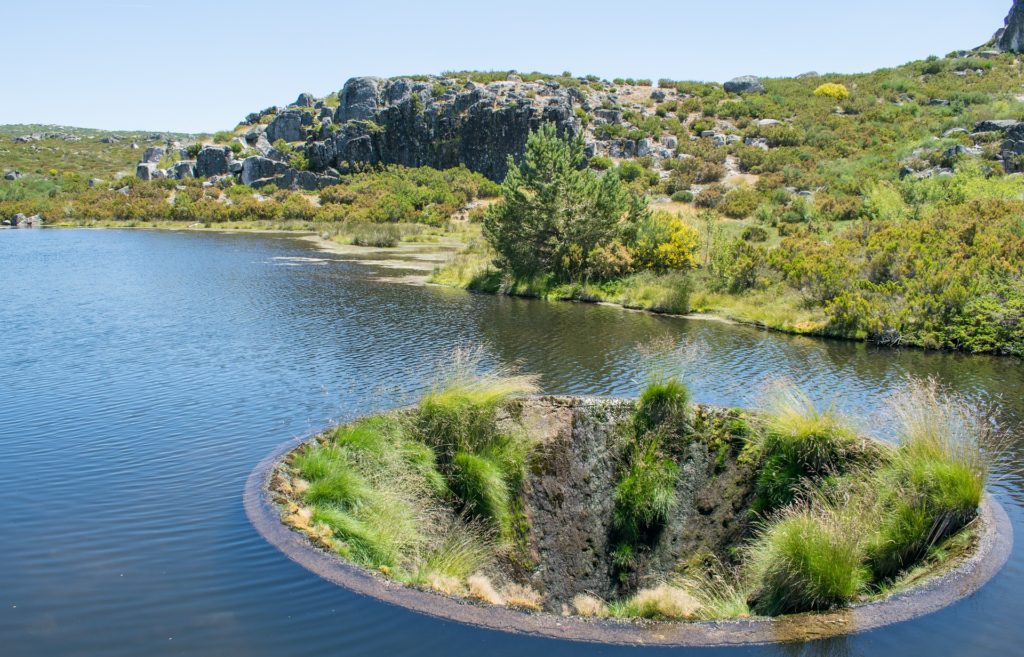
The second lake is also situated in Portugal but on the mainland. It is an artificial lake called Covao dos Conchos. Located in the Serra da Estrela mountains and it is famous for its Bell-mouth spillway
 Beautiful Lake
It was created in 1955 during the construction of the nearby hydroelectric dam. Instead of building a pipeline to channel water between Lagoa Serra da Estrela and Lagoa Comprida, the engineers working on the project decided to drill a tunnel through the mountain to connect the two lakes.
The spillway is designed to provide nearby communities with fresh water. But the fact that no other constructions are present nearby makes the funnel seem more like a part of the lake than a part of an infrastructure project. What’s more, there are plants growing around the edges of the concrete and granite drainpipe. Thus making the giant hole look even more natural. This sci-fi-looking spillway was a little-known secret in Portugal until photos of the hole went viral in 2016.
Stunning glacial lakes
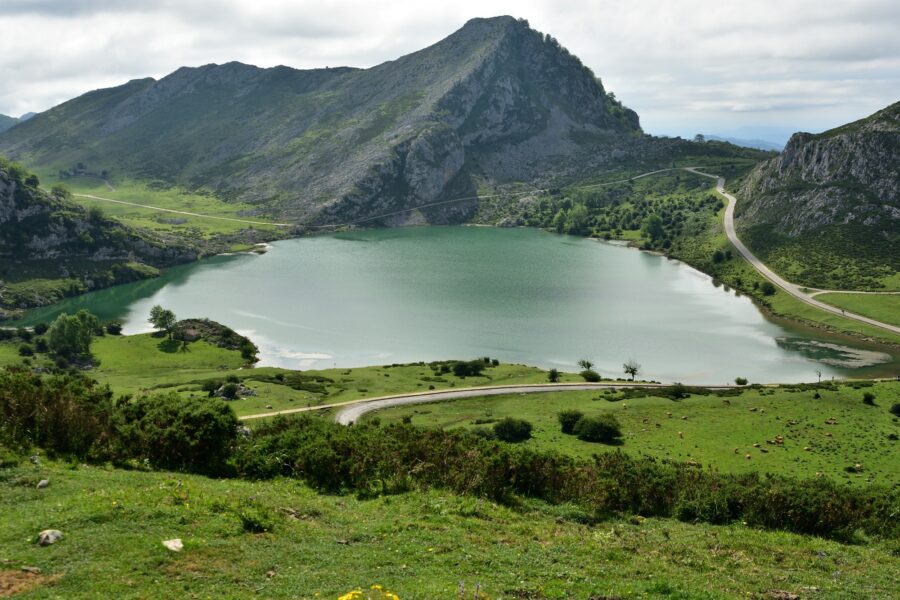
For our third lake, we head over to northern Spain and the Asturias. The Lakes of Covadonga (el. 1134 m.) are composed of two glacial lakes located in the region of Asturias, Spain. These lakes, often also called Lakes of Enol or simply Los Lagos. Lake Enol and Lake Ercina located in the Picos de Europa mountain range and they are the original centre of the Picos de Europa National Park, created in 1918.
 Stunning lake in the mountains
The road ascending from Covadonga to the lakes is a popular climb in professional road bicycle racing. The road having been used for the Vuelta a España many times in the last 25 years. The Vuelta a España (Tour de Spain) is an annual multi-stage bicycle race primarily held in Spain,
 Spanish Lake[/caption]
The stunning glacial lakes of Enol and Ercina make up the Lakes of Covadonga, and when they begin to thaw a third lake forms, Bricial. Bricial disappears once the thaw is over. The Lakes of Covadonga have gained in popularity, leading to an influx of people visiting the area, especially during high season.
 Spanish Church
The Covadonga area is home to a religious sanctuary which consists of a basilica, a holy cave, a museum and a Collegiate church. The grand basilica can be seen for miles around as its two spires are distinctive and Covadonga sits half-way up a mountain.
Lakes of Don Quixote
If you are really a lover of lakes, this last tip is for you; the Lagunas de Ruidera Natural Park. This is a natural park situated in Spain on the La Mancha plain. This area has not just one lake, but in fact 16 smaller lakes connected by waterfalls and rivers. It is considered to be the source of the Guadiana River. The lakes are featured in Cervantes’ famous story Don Quixote although he says there are 7 lakes and not the factual 16. However, perhaps Don Quixote had a hallucinogenic spell after one of the many heatwaves so common on the plains?
 Spanish wonderful sight
The 16 lakes are very different from each other, each with its own distinct character. Some also attract a wealth of wildlife.
The protected area of the Parque Natural de Ruidera includes not only the lakes but also the tributary valley of San Pedro. With the ruins of Rochafrida castle and the cave of Montesinos, which also plays an important part in the story of Don Quixote. You can find the ruins of the castle close to the cave overlooking a cultivated field. It might have been a shallow pool before it was filled in by land reclamation.

So, if waves and sandy beaches aren’t your thing, perhaps the lovely lakes are your next destination?