Because a piece of ham and a glass of red wine is all you need
Spain and Portugal are famous for their delicious Jamons or hams. What you perhaps didn’t know is that although they might look similar, legs hanging from a rack, there are actually many different sorts of ham. The best and perhaps the most famous is a variety called Iberico Jamon. It is produced in both Spain and Portugal and comes in different qualities dependent on the animal, the animal feed and the time it is cured.
Pata negra is the finest ham
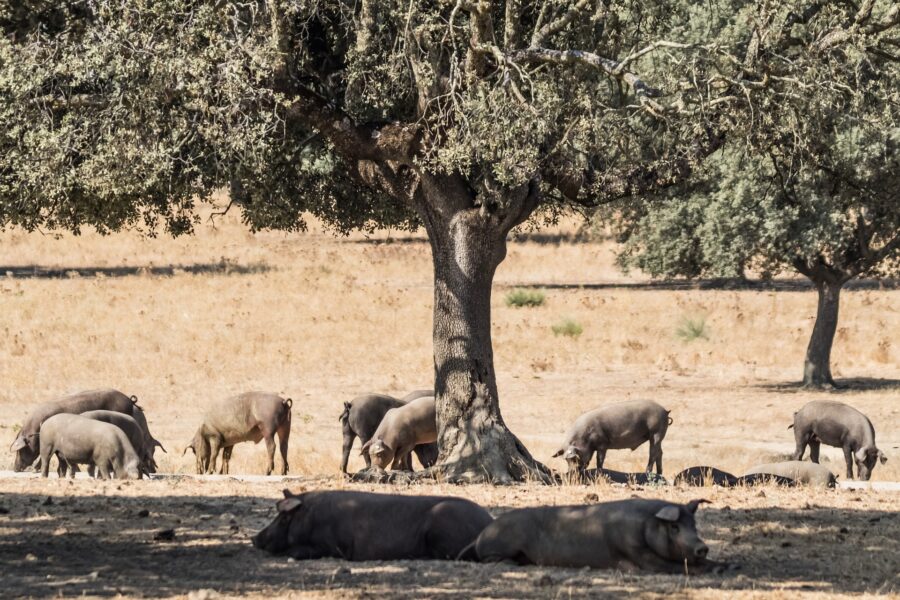
The very highest quality ham is called ‘pata negra’, meaning black hooves in Spanish. As of 2014, the term ‘pata negra’ refers exclusively to the black label grade, jamon iberico de bellota, meaning pure-bred Iberian pigs fed an acorn only diet. In Spain, the black Iberian pig is typically found in the provinces of Huelva, Cordoba, Caceres, Badajoz, Salamanca, Ciudad Real, and Seville. As a general rule, when buying a leg of ham, the black hoof should indicate it being an iberico ham, but there are scams where the nails have been manually painted black.
In Portugal, the central and southern regions have an abundance of the black pigs, especially in the Alentejo region. In Portugal, the black Iberian pig is often referred to as porco preto iberico or porco alentejano. The black pig is an important part of the local Portuguese culture and tradition, with annual festivals in their honour, such as the Feira do Porco Preto, an annual festival in the region of Ourique. This festival is typically held in March.
Jamon iberico de bellota
The jamon iberico de bellota is from free-range pigs that roam oak forests (called dehesas) along the border between Spain and Portugal and eat only acorns during their last period. After slaughter, the meat is covered in salt for some weeks and then washed before being hung dry for 36 months. This grade is divided into two sorts; black-label jamon 100 percent iberico de bellota, produced from pure-bred Iberian pigs, and red-label jamon iberico de bellota from free-range pigs that are not pure-bred. Since 2014, the percentage of Iberian ancestry in the animal must be specified on the label.
The next grade is called jamon iberico cebo de campo. This ham is also from free-range pigs, but not necessarily 100 percent purebred. They have been fed a combination of acorns and grain. As of 2014, this ham bears a green label.
The fourth type is called jamon iberico de cebo, or simply jamon iberico. This ham is from pigs that are fed only grain. The ham is cured for 24 months. As of 2014, this ham bears a white label.
Fattier, richer flavour
Jamones de bellota are prized both for their smooth texture and rich, savoury taste. A good iberico ham has regular flecks of intramuscular fat (marbling). The fat content is relatively high compared to jamon serrano, thus giving it a richer taste.
Serrano or mountain ham
A Spanish serrano ham (jamon serrano) is a different ham altogether. It is means “ham from the sierra, or mountain range”. The name refers to the curing sheds that traditionally were built in elevated positions often in the mountains. It is made with regular white pigs. Fresh hams are trimmed and cleaned, then stacked and covered with salt for about two weeks. The salt is then washed off and finally, the hams are hung in a cool, dry place. Depending on the climate, as well as the size and type of ham being cured they hang between 6-18 months. In Portugal, you will find Presunto, apart from jamon iberico. It is also a dry-cured ham.
Know what to look for
So, when you go to your local supermercado or market and look at all the hams, you now know what to look out for. Since 2014 all Iberico hams must be labeled. The colours of the label indicate the quality (the type of animal, animal feed and for how long the ham has been cured), BLACK LABEL (Jamon 100% Iberico de Bellota), indicates a pure-bred Iberian pig which has been fed only on acorns during the winter period (October to February). It is free-range, being allowed to roam around the dehesa. Its taste is fantastic, and the animals have lived a quality life before slaughter. Depending on size, the allowed number of pigs per hectare is 0.25-1.25. RED LABEL (Jamon Iberico de Bellota) indicates that the ham is part-Iberian, the percentage of Iberian breed must be specified. The pig has been allowed to roam free, eating acorns. GREEN LABEL (Jamon Iberico de Cebo de Campo) indicates that the pig is at least 50% Iberian. It has also been allowed to roam freely, eating both natural grazing and fodder. WHITE LABEL (Jamon Iberico de Cebo) indicates that the pig is at least 50% Iberian and has been kept enclosed in a pen and given fodder. Pigs heavier than 110 kg must have at least 2 square metres of space each.
Jamon as tapas
If the ham is not made with black Iberian pigs the label will state which area it comes from and for how long it has been cured. It will be mostly white pigs used. Most hams are being sliced thinly and eaten as they are as tapas with a piece of bread and a glass of red wine “ that is really all you need. Some of lesser quality ham might also be cut in cubes and added to different cooked dishes. Buen provecho