When we search for a property, it may seem that we are looking for a place. A city. A town. A neighbourhood. A postcode.
But in reality, very few property decisions start there.
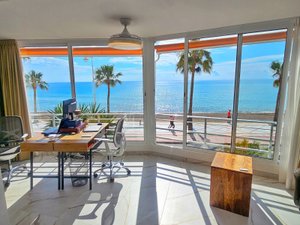
They often begin with much more personal thoughts: I want to be close to the sea, I need easy access to the airport, I want somewhere peaceful, but I don’t want to feel isolated, I’d like to be able to walk to restaurants, or I want a home where I can work remotely while still being surrounded by nature.
That is why understanding how to choose an area to buy a property goes far beyond identifying a location on a map.
There is an administrative geography made up of cities, municipalities, neighbourhoods and postcodes. But there is also another, much harder-to-define geography: the geography of the buyer.
And the two do not always match.
We Don’t Search for Postcodes. We Search for a Way of Life
For decades, digital property search has been built around a fundamentally geographical logic.
First, you select a country. Then a region or province. Next, a city or town. Finally, you apply filters such as price, number of bedrooms, property size or property type.
This works well when the buyer already knows exactly where they want to live.
But what happens when they don’t?
This is particularly common when searching for property internationally.
Someone considering buying a home in another country may not be familiar with its administrative divisions, local place names or the differences between neighbouring areas.
But they may know exactly what they are looking for.
They may want a property:
- – within an hour of an international airport;
- – close to the coast;
- – in a quiet area;
- – with access to year-round amenities;
- – near golf courses;
- – in a rural setting, but with good transport links;
- – or close enough to a city without actually living in one.
In these situations, searching for a property by location becomes about much more than names.
It becomes a question of distances, relationships and preferences.
Administrative Geography and Personal Geography Are Not the Same
A map divides territory according to administrative boundaries.
A buyer, however, divides it differently.
For one person, two properties in different municipalities may effectively belong to the same area because both are within twenty minutes of the place that matters most to them.
For someone else, two properties within the same municipality may offer completely different lifestyles.
Actual travel times, transport links, surroundings and amenities can be far more important than the administrative name attached to a property.
This is where the idea of the emotional geography of property search comes in: the mental map each buyer creates based on the life they want to build in a particular place.
It is not simply about where the property is.
It is about what that location makes possible.
How to Choose an Area to Buy a Property: Start with Your Needs
When the ideal location has not yet been clearly defined, it can be useful to reverse the traditional search process.
Instead of starting with:
Which city do I want to buy in?
we can start with:
How do I want to live?
From there, much more meaningful criteria begin to emerge.
What needs to be close?
The concept of “close” is probably one of the most personal aspects of a property search.
For one person, it may mean ten minutes on foot.
For another, thirty minutes by car.
Airports, schools, hospitals, beaches, shopping areas, railway stations, restaurants and business districts can all become reference points around which a property search is built.
What are we willing to compromise on?
Not every preference carries the same weight.
One buyer may be willing to move five kilometres further from the sea in exchange for a larger property.
Another may accept a smaller home if they can walk to the beach.
A good property search, therefore, is not simply about accumulating filters.
It is also about understanding which criteria are essential and which ones are negotiable.
What kind of environment are we looking for?
Location also has a less measurable dimension.
- – Peace and quiet.
- – Activity.
- – Nature.
- – Urban life.
- – Privacy.
- – Accessibility.
- – Proximity to international communities.
These characteristics are difficult to reduce to a postcode, yet they can ultimately be decisive when choosing a property.
A Map Can Become a Decision-Making Tool
This is where technology is gradually changing the way people search for property.
A property map no longer has to serve simply as a way of showing where individual listings are located.
It can also be used to define where we want to search.
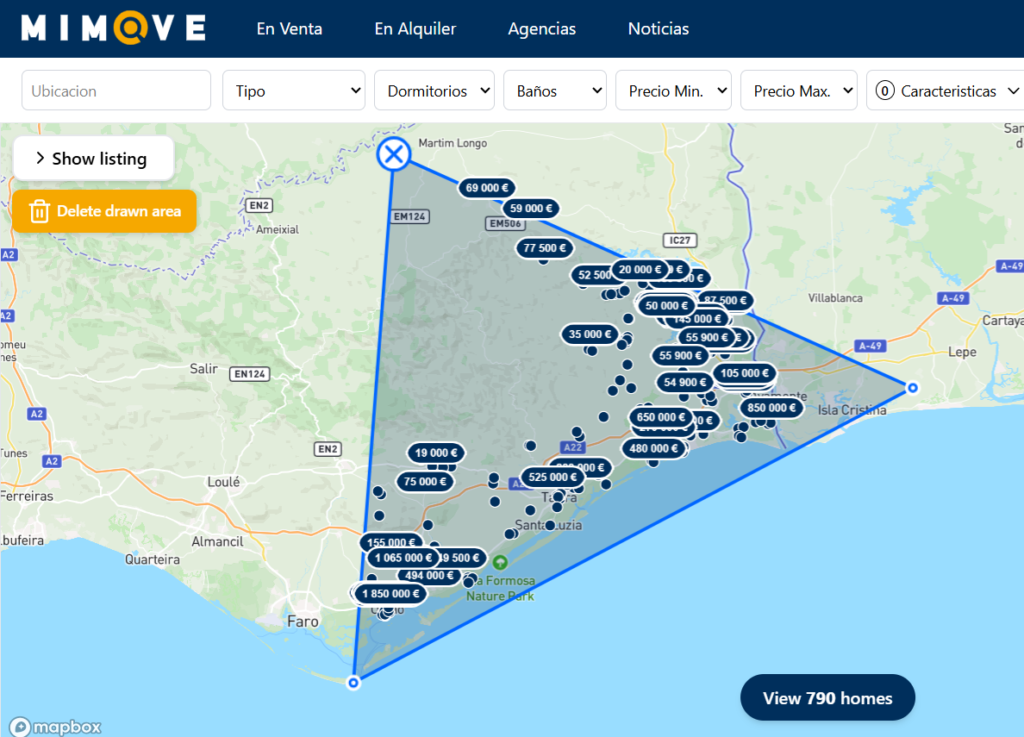
The ability to explore an area visually allows buyers to move beyond traditional administrative boundaries and create search areas based on their actual interests.
Instead of selecting a single town, the buyer can think in terms of an area.
They can include parts of several municipalities.
Follow a stretch of coastline.
Expand a search around a city.
Or exclude areas that do not fit their needs.
This small change can fundamentally alter the search experience.
The buyer no longer has to adapt to the structure of the search engine.
The search engine starts adapting to the buyer.
From Known Locations to Discovery
This approach becomes particularly valuable when buying in a market the buyer does not know well.
Imagine an international buyer interested in purchasing a property near Málaga.
They may initially search for “Málaga”.
But what they really need may be to live within a reasonable distance of the airport, have access to the coast and find a property with specific characteristics within their budget.
Once those variables are introduced into the search, the relevant territory may change.
New towns appear.
Previously unknown areas become interesting.
And a search that initially seemed limited to a single geographical name becomes a process of exploration.
That discovery has real value.
Because a property platform should not only confirm what the user already knows. It can also help them discover options that match their preferences but that they did not yet know existed.
So, What Is the Best Area to Buy a Property?
There is probably no universal answer.
The best area is not necessarily the most famous, the most expensive or the one that produces the largest number of search results on a property portal.
It is the area that best balances each buyer’s priorities.
That is why, before deciding where to buy a property, it can be useful to create a simple hierarchy:
Essential requirements: the things you are not prepared to compromise on.
Important preferences: features that carry significant weight but allow some flexibility.
Nice-to-have features: elements that would improve the choice, but should not determine it entirely.
This approach makes it possible to broaden the search area without losing relevance.
And in many cases, it can lead to better opportunities.
A More Human Approach to Property Search
Paradoxically, the more advanced technology becomes within the property industry, the greater its ability to understand deeply human behaviour.
Because people do not buy coordinates.
-They do not buy a postcode.
-And they do not even buy a property alone.
-They buy the possibility of waking up close to the sea.
-Of reaching the airport easily.
-Of walking to a restaurant.
-Of working with a view of nature.
-Of having more space.
-Of finding peace and quiet.
Technology in the property sector therefore faces an increasingly interesting challenge: turning those human preferences into more flexible and intelligent ways of exploring the places where people may want to live.
At MiMove, tools such as map-based search and the ability to draw a specific area allow buyers to explore properties from this perspective: rather than limiting a search to the name of a particular place, they can define the territory that genuinely matters to them.
Because perhaps the most useful question is not:
“Which postcode do you want to buy in?”
But something much simpler:
“Where is the life you are looking for?”