Buying property in Bali: what to know first
Bali attracts buyers from many countries, whether they want a holiday home, a place to live or retire, or a property to let. Buying here is not like buying at home. Foreigners cannot own freehold land, and in 2026 the island tightened its rules on nominee deals, licensing and zoning, so the legal structure and the checks matter more than the view.
What changed in 2025–26
Several rules changed in 2025 and 2026. As of November 2026, these matter most to foreign buyers:
- Nominee deals banned: Indonesian law already voids any deal that puts freehold in a local’s name for a foreigner. Since 24 February 2026, Bali’s Regional Regulation 4/2026 also bans nominee ownership outright and sanctions anyone who brokers one.
- Unlicensed rentals delisted: From 1 August 2026, at the Tourism Ministry’s request, booking platforms began removing villas that lack a valid business licence.
- Farmland and hotel curbs: After the September 2025 floods, the province told regencies to stop converting productive rice fields, and six regencies, though not Badung, Gianyar or Denpasar, agreed not to encourage new hotels.
- VAT relief on new homes: For handovers during 2026, the government pays the VAT on the first IDR 2 billion of a new, ready-to-occupy home priced at up to IDR 5 billion.
- Higher tax valuations: Badung revalued land in 2025, and Denpasar raised official values by up to 300% for 2026 before cutting bills on homes.
- Retirement visas from 55: The minimum age fell from 60 to 55, and retirees need an income of US$3,000 a month.
- Tourist levy and record arrivals: Foreign visitors pay a one-off levy of IDR 150,000 per trip, KITAS and KITAP holders excepted, and arrivals reached a record 6,948,754 in 2025, up 9.7% on 2024.
Why Bali appeals to buyers from abroad
A culture woven into daily life
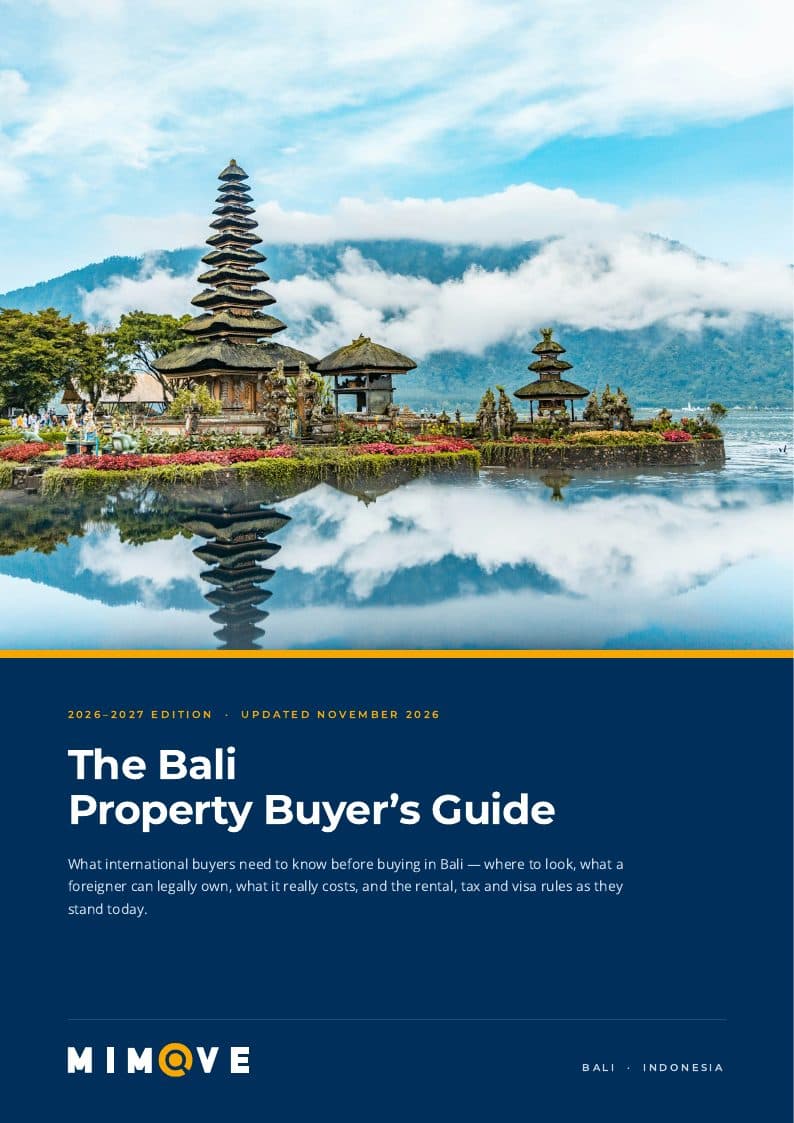
Culture is a large part of Bali’s appeal. Temples, ceremonies and craft villages are part of everyday life, and Ubud is regarded as the island’s cultural heart. Owning a home lets you live alongside that tradition instead of visiting it for a week.
Coast, cliffs and rice terraces: the main areas
Surf beaches and limestone cliffs line the south-west coast and the Bukit, while terraced rice fields surround Ubud in the uplands. Most foreign buyers focus on the coast and Ubud:
- Canggu, Berawa and Pererenan: Surf, cafés and co-working, and the island’s busiest villa market. Many plots were rice fields, so check the zoning.
- Seminyak, Kerobokan and Umalas: The established upscale district, with the highest land prices on the west coast, and leafier family streets inland.
- Uluwatu and the Bukit: Cliffs, surf breaks and ocean views, with fast growth that water supply and roads are still catching up with.
- Jimbaran and Nusa Dua: Calm bays near the airport; Nusa Dua is a planned enclave of large resort hotels.
- Sanur: A long, reef-sheltered beach and an established expat community, suited to families, retirees and long stays.
- Ubud and the uplands: Greener and cooler, with villa prices generally below the coast, steadier longer-stay rental demand and the beach about an hour away.
- Tabanan and the east: These regencies have agreed not to encourage new hotels, so check what may be built before you buy land.
Growing international interest
Bali’s buyers range from retirees and families to remote workers and investors, the last two drawn especially to Canggu. Foreign arrivals set a record in 2025, with Australia the largest market.
Visitor demand for rentals
All those visitors need somewhere to stay, so many buyers plan to let their home while they are away. The demand is real, but holiday letting is now licensed and enforced.
The main types of property in Bali
Villas, the island’s signature home
Most foreign buyers picture a private villa with its own pool and garden, to use, live in or, with the right licence, let. About nine in ten villas for sale are leaseholds. Before you commit, check the permits as well as the roof, timber and air-conditioning, which the climate wears down fast.
Leasehold, the usual route
With a leasehold (Hak Sewa) you rent the land, and usually the villa, from its Indonesian owner for a term set in the contract, often 25–30 years, and no residence permit is needed. The median villa listing has around 25 years left, and an advert for “80 years” often means 30 + 20 + 30, where only the first term is certain. Have any extension, its price and what happens to the building at the end written into the contract.
Buying off-plan
Many new villas and apartments are sold before or during construction, usually on a developer’s stage-payment plan. Link each payment to a building milestone, agree completion dates and penalties, and ask how your deposits are protected if the project stalls.
Commercial premises
A foreigner who wants to run a business from Bali premises does so through a PT PMA, a company that needs a real business purpose and must meet investment and capital rules. Typical premises include:
- Restaurants and cafés: Serving visitors and residents, on land zoned for the use.
- Shops and offices: Subject to the same checks on zoning and permits.
Resort villas and units
Some buyers choose a villa or unit in a resort, or a share in one, let by an operator while they are away. If an income is promised, ask:
- Who pays it, and out of what revenue
- What happens if the operator stops
- Which lease or title the unit sits on, and for how many years
Be wary of any “guaranteed yield”. Branded hotels averaged 60–79% occupancy in 2025, and private villas usually do worse.
Step by step: how a foreigner buys in Bali
What the law allows a foreigner to own
Foreigners cannot own freehold land in Bali: freehold title (Hak Milik) is reserved for Indonesian citizens. A foreign buyer has three legal routes instead, and the one you choose decides how long you keep the property and what you may do with it:
- Leasehold (Hak Sewa): A private lease with the landowner, signed before a notary, for an agreed term, often 25–30 years. It is open to anyone and is the usual choice for villas and holiday homes.
- Right of use (Hak Pakai): Registered in your own name and open to a foreigner with Indonesian immigration documents, for up to 30 + 20 + 30 years on state land, each step by application. It covers one house on up to 2,000 m² or one apartment per person, at a minimum price of IDR 5 billion for a house or IDR 2 billion for an apartment, and suits a home you live in.
- Your own company (PT PMA): A foreign-owned Indonesian company holds building rights (HGB) for 30 + 20 + 30 years. It brings set-up costs, annual accounts and tax filings, and is the only way a foreign owner can hold a villa rental licence.
Never use a nominee. Putting land in an Indonesian friend’s name, “secured” by side agreements, is void under Article 26 of the Basic Agrarian Law and banned in Bali since February 2026. If it is challenged, the land can pass to the state and your money may be lost, so walk away from any seller who suggests it.
Fit the structure to your plans
Settle the route before you shortlist, because it narrows what you can buy. Some routes need an Indonesian tax number (NPWP), and Hak Pakai needs a visa or stay permit, so check what yours requires first.
Your own lawyer and notary
Your lawyer is your most important appointment, so choose one licensed in Indonesia, independent of the seller and the agent, fluent in your language and used to foreign buyers. Pick the notary (PPAT) yourself too, agree fees in writing and make sure the checks cover:
- The land certificate at the land office (BPN), and who really owns the land
- The zoning (RDTR)
- The building permit (PBG) and the certificate of occupancy (SLF)
- Any unpaid land and building tax (PBB)
- Whether a rental licence is possible, if you plan to let
Choosing an agent
A good local agent knows the areas, the developers and the paperwork, and every listing on MiMove names the agency behind it. An agent is no substitute for your own lawyer, though, and a reservation deposit should be refundable if the checks fail and paid only through a receipted channel.
Signing and registration
The contract should fix the lease term, any extension and its price, who pays the landowner’s tax and the annual PBB, and what happens at the end, or for off-plan the stage payments, completion dates and penalties. A title transfer is then signed as a deed before your PPAT, once the seller has paid their 2.5% tax, and payments inside Indonesia must be in rupiah.
After signing a title transfer, you pay the acquisition tax (BPHTB), and the right is registered in your name at the land office. Keep every deed, permit, receipt and tax notice in one file.
Bali property as an investment
Rental income in practice
Holiday letting needs a business licence: a business number (NIB) under the villa activity code, which for a foreign owner sits in a PT PMA, as the simpler homestay licence is for Indonesian citizens only. The building also needs its PBG and SLF on land zoned for tourist accommodation, and unlicensed villas have been delisted since 1 August 2026.
Branded hotels averaged 60–79% occupancy in 2025, but short-term rentals in Canggu managed about 36% over the year to July 2026. Plan on your own conservative figures after the manager’s share, the 10% accommodation tax (PBJT) and maintenance. Yearly lets are simpler, taxed at a final 10% of the gross rent, with strong demand in Canggu, Umalas and Sanur.
Judging the investment case
Much depends on what you buy and how you hold it. A lease loses value every year, because a later buyer pays only for the years left, so plan your exit or extension early and judge a purchase on net income rather than brochure yields.
Setting Bali against other markets in the region
Comparisons with other Southeast Asian markets only work if you compare like with like. Here a foreigner usually buys a fixed number of years on a lease, not land, so weigh the price against the years left and the income the property can legally earn after costs.
The direction of the market
No one can say how prices will move, but policy points one way: tighter rules on nominee deals, licensing and zoning, and limits on farmland conversion and new hotels. Missing permits can block a licence, a sale or your insurance, so clean paperwork is what protects a purchase.
What buying property in Bali costs in taxes and fees
Buying a registered title such as Hak Pakai or HGB costs the buyer roughly 6–8% on top of the price. A leasehold costs far less to buy, because no title changes hands, but you are paying for a fixed number of years.
The annual land and building tax
The land and building tax (PBB-P2) is charged each year on the official valuation (NJOP), not the price. In Badung it is 0.2% below IDR 1 billion and 0.3% above, after a small allowance, and on a leasehold the landowner usually pays. Valuations have jumped in Badung and Denpasar, so ask for the last three years of PBB notices before you pay a deposit.
Taxes when a property changes hands
Each tax on a purchase falls on a different party. Your contract should say who carries what:
- Acquisition tax (BPHTB), buyer: Up to 5%, at the regency’s rate after an IDR 80 million allowance, on a title transfer such as Hak Pakai or HGB, not on a leasehold.
- Income tax (PPh), seller: 2.5%, paid before the deed is signed. Check that the agreed price is net of it.
- Lease tax, landowner: A final 10% on the payment for a new lease.
- VAT, new builds: About 11% in effect, charged by a VAT-registered developer.
Notary, legal and company costs
The notary (PPAT) fee is capped by law at up to 1%, your lawyer adds about 1%, and a PT PMA costs about US$1,600–4,500 to set up. At the IDR 5 billion Hak Pakai minimum, acquisition tax of IDR 246 million plus notary and lawyer come to about IDR 346 million, or 6.9%, before any VAT, against about 2% on a leasehold.
Where the rules help the buyer
Not every rule adds to the bill. Two work in the buyer’s favour:
- VAT relief in 2026: Until 31 December 2026, the state covers the VAT on the first IDR 2 billion of a new, ready-to-occupy home priced at up to IDR 5 billion, and a foreign buyer with an Indonesian tax number who meets the ownership rules can qualify.
- No acquisition tax on a lease: BPHTB applies only when a title changes hands.
Living in Bali: visas, residence and daily costs
Owning property in Bali does not give you the right to live in Indonesia. Your visa depends on your age, income or savings, and a Hak Pakai title requires one.
The main visa routes
Indonesia offers several ways to stay. As of November 2026, the main options were:
- Visa on arrival: For many nationalities, IDR 500,000 for 30 days, extendable once for 30 more.
- Second Home Visa (E33): Up to five years, with no sponsor and no work in Indonesia. Within 90 days you place IDR 2 billion in a state-owned Indonesian bank in your own name, or own qualifying property worth US$1 million.
- Retirement visas (E33F and E33E): From age 55, with an income of US$3,000 a month. E33F runs a year at a time with a local sponsor; E33E runs up to five years without one, against a US$50,000 state-bank deposit.
- Remote worker visa (E33G): For employees of a company outside Indonesia earning at least US$60,000 a year, with US$2,000 in the bank. It runs one year, can be extended and allows no work for Indonesian clients.
- Investor and Golden Visas: For investment through an Indonesian company or large qualifying investments, with thresholds from the hundreds of thousands of US dollars.
Rules and thresholds change often. Check the official e-visa portal before you apply.
Stay permits and tax residence
Holders of a long-term stay permit can later move to a KITAP, the permanent stay permit, which runs five years and ends the yearly renewal. Spending more than 183 days in Indonesia in 12 months, or holding a permit valid for longer, can make you tax resident on your worldwide income unless a treaty says otherwise, and no official source exempts remote workers’ foreign income.
Everyday living costs
Day-to-day costs depend on where and how you live. Running a home is modest by Western standards, though air-conditioning and pool pumps drive up the electricity bill, and water, internet, security and garden staff all add to it.
Healthcare and local services
Care on the island ranges from private hospitals to small neighbourhood clinics, and quality and cost differ between them. Arrange health insurance that covers you in Indonesia, and insure the home’s building and contents too, with liability cover if guests stay.
Paying for your purchase: currency and transfers
Indonesian mortgages are rarely open to foreign buyers, so most pay cash or follow a developer’s stage-payment plan. Payments inside Indonesia must be in rupiah, and on a six-figure sum a small move in the exchange rate can cost more than your legal fees:
- Use a regulated currency specialist rather than a high-street bank, and compare the total cost, fees included, with your bank’s margin.
- Consider a forward contract to fix the rate for your deposit and completion.
- Send off-plan payments in stages that follow the payment schedule.
- Keep proof of every transfer for the notary and the tax office.
Plan each transfer ahead of its due date. Converting in a hurry, or at an airport desk, rarely gets a good rate.
The main points to remember
Foreigners cannot own freehold land in Bali, but a lease, Hak Pakai or a PT PMA lets you buy within the law, and a nominee never does. Check the zoning, the permits and any rental licence, budget for the taxes and the upkeep, and arrange your visa separately, because owning property gives you no right to stay.