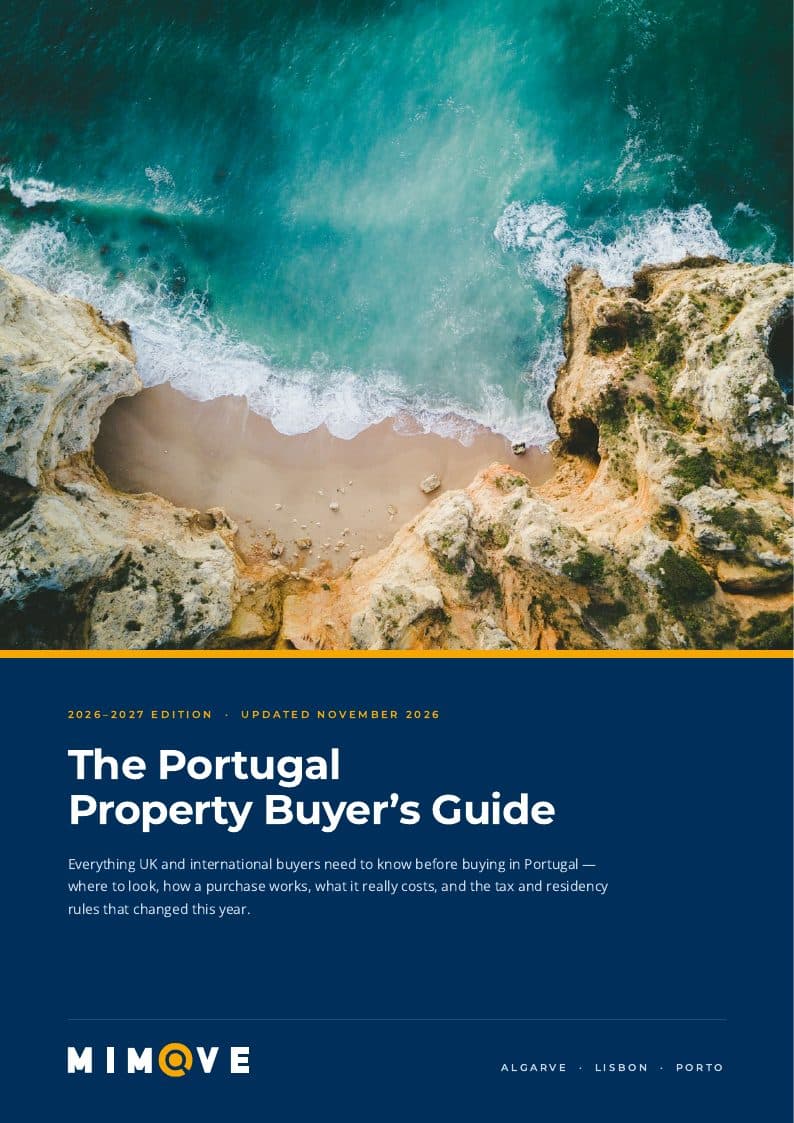
Buying property in Portugal from abroad
Portugal has something for almost every buyer, from the beaches and golf courses of the south to historic cities and green countryside in the north. Whether you want a place to retire, a holiday home or a long-term investment, the choice is wide.
Buying from abroad is well within reach with the right people beside you. A purchase follows a set, notarised sequence, and a lawyer holding your power of attorney can handle much of it while you are at home.
Why buyers choose Portugal
Sunshine, a long Atlantic coast, good food and an unhurried way of life explain much of Portugal’s pull. The rules, however, have moved a lot in recent years, so start with what is new.
What changed in 2026
Several measures that matter to buyers took effect in May 2026. Two older changes still catch people out.
- A flat 7.5% IMT for non-residents: Decree-Law 97/2026, gazetted on 20 May 2026, sets property transfer tax (IMT) at 7.5% on residential purchases by non-residents, whatever the price. It can be avoided or reclaimed if you become Portuguese tax resident within two years or let the home at a moderate rent for at least 36 months. A legal challenge is expected, so confirm the rate on your completion date.
- Citizenship takes 10 years: Since 19 May 2026, naturalisation needs 10 years’ legal residence, up from 5, or 7 for nationals of the EU and of the Portuguese-speaking CPLP countries, counted from your first residence permit.
- Platforms check short-let licences: Since 20 May 2026, EU Regulation 2024/1028 has required platforms to verify each Alojamento Local (AL) registration number before a listing goes live. Councils have also cancelled more than 10,000 inactive registrations nationally.
- No Golden Visa through property: Real estate stopped qualifying in October 2023. The main remaining route is a €500,000 subscription to a regulated fund with no real-estate exposure, so a home will not unlock residency.
- NHR has closed: Its narrower successor, IFICI, is covered in the tax section below.
A mild climate in every season
The Algarve is mild all year, Lisbon is Europe’s sunniest capital and coastal winters suit long stays and retirement. In the south, spring, autumn and the golf seasons also stretch demand well beyond summer.
A relaxed and welcoming way of life
Portuguese life is friendly and unhurried, with history on show in old city quarters, cobbled market towns and fishing harbours. Settled communities such as Albufeira’s year-round expat population make arriving easier, while Tavira and Loulé keep a distinctly Portuguese rhythm.
Where most international buyers look
Lisbon, Porto and the Algarve are the usual starting points, and they are three very different markets. Lisbon offers liquidity and long-term demand, Porto value and renovation, and the Algarve lifestyle, golf and holiday lets.
For expats and retirees: the residency rules
Portugal suits retirees and remote workers as well as holiday-home owners. Owning property does not, by itself, give you the right to live here, though: that depends on your citizenship or the right visa.
- EU, EEA and Swiss citizens: An automatic right to live here; register with the local council within three months.
- Non-EU visitors: Up to 90 days in any 180 in the Schengen area, now logged by the EU’s Entry/Exit System.
- D7 passive-income visa: Income of at least the minimum wage, €920 a month in 2026, plus 50% for a spouse and 30% per child.
- D8 remote-work visa: At least €3,680 a month in 2026, four times the minimum wage, from work for clients outside Portugal.
Thresholds reset each January with the minimum wage. Take advice from an immigration lawyer before applying.
A clear process, step by step
Portugal uses a notarised system: the sale completes when both parties sign the deed before a notary or another authorised official. A typical resale takes two to three months from accepted offer to keys.
- NIF and lawyer: Before you offer, obtain a Portuguese tax number (NIF), open a local bank account and instruct an independent, bilingual lawyer, usually with a power of attorney to act for you remotely.
- Reservation: A reservation agreement takes the property off the market, usually against a fee of around €3,000–€6,000 held by your lawyer.
- Due diligence: Over two to three weeks, your lawyer checks the registry certificate (certidão permanente), tax record (caderneta predial), licence of use, energy certificate, debts and charges, condominium accounts and any AL registration.
- Promissory contract (CPCV): A binding contract fixing the price, terms and completion date, with a deposit of typically 10–30%. A buyer who withdraws loses it and a seller who defaults repays double, so finish due diligence and finance first.
- Completion: With IMT and stamp duty paid, the deed (escritura) is signed, the balance transferred and the keys handed over. Your lawyer then registers you with the land registry and tax office.
- Afterwards: Set up utilities and insurance, sign up for the tax office’s electronic notifications or appoint a fiscal representative, and diarise your annual IMI bill.
Funding your purchase: mortgages, currency and costs
Mortgages for non-resident buyers
Portuguese banks do lend to non-residents, typically 60–70% of the lower of the price or valuation, over terms of up to 30 years. Most lenders want the loan repaid by age 70–75, and Banco de Portugal caps total debt repayments at 50% of income.
Expect to show two to three years of income evidence, tax returns and bank statements, and to pay around 1–2% of the loan in costs, including stamp duty of 0.6% on the loan. An approval in principle, arranged early, strengthens your offer.
Moving your money into euros
On a six-figure transfer, a small move in the exchange rate can cost more than your legal fees. The margin in a bank’s rate is largely avoidable with planning.
- Compare an FCA-regulated currency specialist, or your country’s equivalent, with your bank’s rate and fees.
- Open the account before you start viewing, so you can move quickly.
- Fix the rate for the deposit and completion payments with a forward contract.
- Move money in stages as the contract requires, rather than converting everything at the last minute.
What buying costs on top of the price
Budget 8–11% on top of the price as a non-resident in 2026, more than the 6–8% many older guides quote. These are the main items.
- IMT for non-residents: A flat 7.5% of the price on residential purchases, avoidable or reclaimable as described above.
- IMT for Portuguese tax residents: Progressive bands, with a zero-rate first band for a main home and 1% from the first euro for a second home, rising to a flat 6% and 7.5% at the top.
- Stamp duty (Imposto do Selo): 0.8% of the price, paid with the IMT.
- Lawyer: Around 1–2% of the price plus VAT.
- Notary and land registry: Around €700–€1,500.
- Mortgage costs: Around 1–2% of the loan.
In our worked example for a non-resident, the taxes, lawyer, notary and registry come to about 10.4% of the price. Your lawyer should confirm the IMT rate that applies on your completion date.
Lawyer, notary and land registry
Ownership passes when the deed is signed before a notary or another authorised official. Registration with the land registry and the tax office follows, and your lawyer handles it.
- Notary: Certifies the deed on completion day.
- Land registry: Records you as owner; its certificate is checked during due diligence.
- Your lawyer: Independent of the seller and agent, registered with the Ordem dos Advogados, fluent in your language and used to overseas buyers.
Agree the fee in writing and ask exactly which checks it covers. An agent may suggest lawyers, but the choice and the instruction are always yours.
Where to buy property in Portugal
Lisbon: a capital with a deep market
Portugal’s lively capital is also its deepest and most liquid market, where demand from an international workforce and students, against a tight supply of homes, keeps prices well above the national average. Owner-occupiers favour Príncipe Real, Estrela and Campo de Ourique, while Cascais and Estoril, 30 minutes west, offer coastal living.
For investors, Lisbon is now a long-let market first. Many central parishes are closed to new short-let registrations and the city cancelled around 6,700 AL licences in its 2026 review, so buying to short-let without an active licence is not a plan.
Porto: history, value and renovation
Compact, historic and set on the Douro, Porto is noticeably cheaper than Lisbon. Its old core is full of buildings needing renovation, which suits buyers who want to add value, while Vila Nova de Gaia across the river and coastal Foz and Matosinhos are popular with families.
Short lets are tightly controlled in the centre, where more than 1,400 AL licences were cancelled in early 2026, so most investors plan on long lets. Qualifying moderate-rent contracts can now be taxed at 10%. Before renovating, check the licence of use and any heritage protection, and have a surveyor scope the works.
The Algarve: three coasts, one airport
The Algarve has 150 kilometres of Atlantic coast, most of it within 90 minutes of Faro airport, and a mild climate all year. Short lets remain broadly possible, but each council sets its own rules, including whether an existing AL licence can pass to a buyer. Never pay extra for a licence your lawyer has not verified.
- Central Algarve: The most developed coast, with the Golden Triangle of Vale do Lobo, Quinta do Lago and Vilamoura, lively Albufeira, cliff-framed Carvoeiro and, inland, the market town of Loulé.
- Western Algarve: Wilder and more dramatic, with cliffs, coves and fishing villages from Portimão and Lagos out to Sagres and Cape St Vincent, and quieter Alvor, Praia da Luz and Burgau.
- Eastern Algarve: From Faro to the Spanish border, the least developed stretch: quieter, more traditional and better value, centred on the Ria Formosa lagoon and year-round Tavira.
Inland and rural areas: space and quiet
The interior offers peace, space and often more land for your budget, though shops and services can be a drive away. Rural land pays IMI at 0.8%, against 0.3–0.45% for urban property.
Extensions, pools and conversions without permits are common, and unregistered works can block a mortgage, a sale or an AL registration. Make the licence of use part of your lawyer’s checks, and have a surveyor inspect anything you plan to restore.
Tax and running costs for owners in Portugal
IMI and AIMI: the yearly property taxes
IMI is charged each year on the rateable value (VPT), which is usually well below market value. Councils set the urban rate at 0.3–0.45%, and 205 of the 308 charge the 0.3% minimum in 2026. Rural land pays 0.8%, and the bill is paid in one to three instalments.
AIMI applies only to residential property with a combined rateable value above €600,000 per owner: 0.7% on the excess, 1% above €1m and 1.5% above €2m. Couples can combine their allowances.
The NHR scheme has closed: IFICI replaced it
The Non-Habitual Resident (NHR) regime is closed to new applicants. Its successor, IFICI, offers a flat 20% rate on qualifying Portuguese work income for up to 10 years, but only in specific roles such as research, higher education, certified start-ups and qualifying tech and industrial jobs.
You must not have been tax resident here in the previous five years, and unlike under NHR, foreign pensions are fully taxable. You generally become tax resident, and taxed on your worldwide income, if you spend more than 183 days here in any 12 months or keep a home as your habitual residence. Leaving can trigger tax at home too, so take advice on both sides.
Other taxes and reliefs worth knowing
- Rental income: Non-residents pay a flat 25% on net Portuguese rental income, with lower rates on long contracts and 10% on qualifying moderate-rent leases. Double-tax treaties, including the UK’s, prevent you paying twice.
- Capital gains: Taxable in Portugal, by an amount that depends on your residency, how long you held the property and whether you reinvest.
- Inheritance and gifts: No inheritance tax as such, but a 10% stamp duty applies. Spouses, children and parents are exempt and pay only 0.8% stamp duty on property, and a Portuguese will for Portuguese assets is worth considering.
Costs beyond tax: running the home
Portugal is not an expensive place to own property, but budget for the running costs as well as the yearly taxes. Ask owners in the same development, and check the condominium accounts, before you buy.
- Condominium fees: Higher in resorts with pools, reception and gardens, low in simple blocks.
- Utilities: Air conditioning and a private pool can raise bills sharply, and many owners add solar.
- Insurance: Buildings and contents cover is strongly recommended and required with a mortgage; if you let, it should cover guests and public liability.
- Tax representation: Owners from outside the EU, the UK included, need a fiscal representative or the tax office’s electronic notifications.
- Key-holding: Most non-resident owners pay a local company to handle the pool, garden, cleaning and check-ups while the home is empty.
Work with an independent lawyer, a qualified tax adviser and, if you are relocating, a cross-border financial adviser. Pensions, ISAs and trusts can be treated very differently in Portugal.