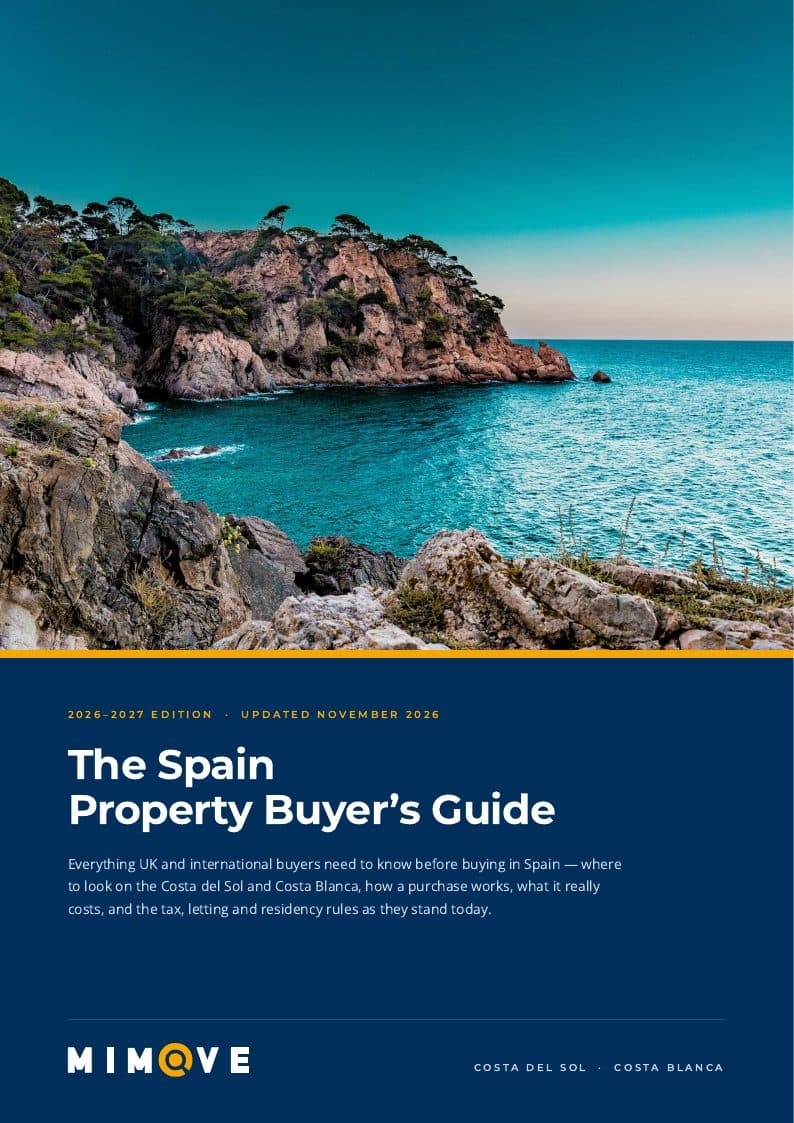
An introduction to buying property in Spain
From a city apartment in Málaga to a villa above the coves of Jávea, Spain offers a wide choice of homes and settings. Sunshine, beaches, golf and good value keep it at the top of Europe’s list for buyers from abroad.
Buying from abroad is more manageable than it may look: the system is clear, notarised and open to foreign buyers, with no restrictions on ownership. The rules have changed a good deal since 2025, though, so this guide sets out the costs, steps and checks as they stand in November 2026, focusing on the Costa del Sol and the Costa Blanca. We have connected international buyers with homes in Spain since 2017.
The Spanish property market at a glance
The market for foreign buyers in 2026
Foreign buyers choose from city apartments, village houses, resale villas and new developments. Prices depend above all on the coast and the town: the western Costa del Sol is the prime end of the market, while the Costa Blanca offers some of Spain’s best-priced beach homes. Listing prices are asking prices, which run above agreed sale prices, so use them to compare areas, not to value a home.
What changed in 2025–26
These are the changes that matter most. Each is shown as it stood in November 2026:
- The Golden Visa has closed: Spain stopped taking new applications on 3 April 2025, so buying property, at any price, no longer leads to residency.
- Owners can veto new holiday lets: Since 3 April 2025, a new tourist let in an apartment block needs prior approval from three-fifths of the community of owners, which can also add up to 20% to that owner’s fees; lets already operating legally continue.
- Registration of short lets: A national registration number (NRA) was required on short-let listings from 1 July 2025 until the Supreme Court annulled the register and the number on 19 May 2026. Regional tourist licences still apply in full, platforms must still report data, and EU rules have obliged them to check registrations since 20 May 2026.
- Lower transfer tax on the Costa Blanca: In the Valencia region, resale transfer tax fell from 10% to 9% for deeds from 1 June 2026, with 11% still due on the whole price above €1m. Andalucía stays at a flat 7%.
- The 100% tax is not law: A January 2025 plan for a 100% tax on non-EU, non-resident buyers was never debated in parliament and was left out of the 2026 housing packages. Check before you sign.
- Rental expenses for non-EU owners: Non-resident owners from the EU or EEA pay 19% on rent with expenses deductible, but non-EU landlords, UK owners included, still pay 24% on the gross. A July 2025 Audiencia Nacional ruling says they should be able to deduct expenses, and the Supreme Court has yet to rule on the appeal.
Where to buy: the Costa del Sol and the Costa Blanca
Madrid and Barcelona suit buyers who want a big city; our guide covers two coasts in two regions, each with its own tax regime. The Costa del Sol, along the Málaga coast in Andalucía, pairs famous resorts with a real year-round city, more than 70 golf courses, excellent healthcare and international schools.
The Costa Blanca runs for more than 200 kilometres along Alicante’s coast in the Valencian Community. Its mild climate, rental demand and lower prices draw British, Dutch, Belgian and Scandinavian buyers.
- Marbella, Benahavís and Estepona: The prime western end, with the Golden Mile, Puerto Banús, gated hillside estates and the new builds of the New Golden Mile.
- Málaga and the resort towns: Málaga city, the region’s cultural and economic heart, plus Fuengirola and Benalmádena with their long promenades, big expat communities and more affordable apartments.
- Nerja and the Axarquía: Quieter and more traditional, with cliffs, coves and white villages such as Frigiliana.
- The northern Costa Blanca: Green hills, coves, old towns and villas in Dénia, Jávea, Moraira, Calpe and Altea, with Jávea the most sought-after and Benidorm one of Spain’s strongest holiday-rental markets.
- The southern Costa Blanca: Flatter and sunnier, from Alicante to Torrevieja and Orihuela Costa, with long beaches, golf, plenty of newer homes and some of the lowest prices on any Spanish coast.
Letting your property: the current rules
Both coasts have strong rental demand, but holiday letting is tightly regulated and long lets favour tenants. Check the rules for the specific property before you offer.
- Holiday lets: You need a regional tourist licence before you advertise, and many towns now limit or pause new ones; Málaga city has suspended new licences on residential land for up to three years from July 2026. Never pay extra for a licence your lawyer has not verified.
- Long-term lets: Contracts run for at least five years, or seven if the landlord is a company, and annual rent rises are capped.
What buying property in Spain costs
Budgeting for the purchase
Where you buy matters, because each region sets its own transfer tax. Budget for two things:
- The agreed price, driven mostly by the coast, the town and the kind of home.
- Purchase taxes and fees of roughly 9–11% on a resale home, a little less in Andalucía, and about 13% on a new build.
In our guide’s worked example for a resale apartment, these come to about 8.7% of the price on the Costa del Sol and 10.7% on the Costa Blanca, the whole difference being transfer tax. Reduced rates exist for some main homes, and your lawyer will confirm the rate on your completion date.
Purchase taxes and fees, region by region
These one-off costs are due on the purchase. Rates are as of November 2026:
- Transfer tax (ITP), resale in Andalucía: 7% of the price, or of the tax value if higher, on the Costa del Sol; a cut to 6.75% has been announced for 2027.
- Transfer tax (ITP), resale in the Valencia region: 9% on the Costa Blanca for deeds from 1 June 2026, and 11% on the whole price above €1m.
- VAT (IVA), new build: 10%, instead of transfer tax, on a first sale by a developer.
- Stamp duty (AJD), new build: 1.2% in Andalucía and 1.4% in the Valencia region, on the deed alongside VAT.
- Lawyer: About 1% of the price plus 21% VAT.
- Notary and land registry: About €1,500–€2,500 together, on a sliding scale.
- Mortgage costs: About €500–€1,500 or more for valuation and arrangement; since November 2018 the bank, not you, has paid the mortgage stamp duty.
If the seller is not resident in Spain, the buyer must withhold 3% of the price and pay it to the tax office on the seller’s account. When you later sell as a non-resident, your own buyer will do the same, and 19% tax is due on your gain.
Running costs after you buy
Keeping a home in Spain is fairly inexpensive, but one tax catches many non-residents out, because it is due even on a property they never let. The yearly costs are:
- IBI (council tax): Typically 0.4–1.1% of the cadastral (tax) value, not the market value, set by each town hall.
- Basura (rubbish collection): Usually about €100–€300 a year.
- Community fees: From about €40 to €300 or more a month for shared pools, gardens, lifts and security; check the accounts and any planned works before you buy.
- Non-resident income tax: Due on a deemed income of 1.1–2% of the cadastral value even if you do not let, at 19% for EU and EEA residents or 24% for others, including UK owners, filed on Modelo 210.
- Wealth tax: On net Spanish assets above €700,000 per person, with a 100% relief in Andalucía and a €2m allowance for Valencia residents from 2026; a separate solidarity tax applies above €3m.
- Insurance: Typically €150–€400 a year for buildings and contents, more for villas; required with a mortgage, and it must cover guests if you let.
- Management and upkeep: Key-holding or management €50–€150 a month, pool and garden €60–€150 a month.
How buying property in Spain works
Finding the right estate agent
The right agent makes the search far easier. Look for one who knows your chosen area, has a solid track record and good reviews, and explains each stage clearly. Agents can usually recommend lawyers they have worked with, but check that any lawyer is independent: the choice is yours.
Getting the paperwork ready: NIE, bank and lawyer
Every purchase needs an NIE, the foreigner’s tax number, which you can get at a Spanish consulate, in Spain or through your lawyer under a power of attorney. Open a Spanish bank account and appoint your own independent lawyer before you reserve, and if you need a mortgage, get an approval in principle first.
Signing, paying the taxes and registering
The purchase completes when you sign the title deed (escritura) before the notary and pay the balance, so ask your lawyer for the full figure, taxes and fees included, well in advance. Your lawyer then pays the transfer tax, or the VAT and stamp duty on a new build, and registers the property in your name at the land registry.
The purchase step by step
A typical resale purchase takes six to twelve weeks from accepted offer to keys, and longer with a mortgage. It follows six stages:
- NIE and lawyer: Get your NIE, appoint an independent lawyer and open a bank account.
- Reservation: A reservation agreement, usually with a deposit of around €3,000–€10,000, takes the home off the market; make sure the deposit is refundable if due diligence fails.
- Due diligence: Your lawyer checks the nota simple (land registry extract), the cadastral record, debts and charges, the licence of first occupation or habitability, any illegal building work, community fees and, if you plan to let, whether a tourist licence is possible.
- Private contract (arras): Usually a 10% deposit. Under the standard arras penitenciales you lose it if you pull out, and a seller who pulls out must pay you double.
- Completion: You sign the escritura before the notary, pay the balance and get the keys; a new build may instead follow bank-guaranteed stage payments.
- Taxes and registration: Your lawyer pays the tax and registers you; you set up utilities, insurance and direct debits.
How to finance a property in Spain
Spanish mortgages for non-residents
Spanish banks lend to non-residents, but each sets its own conditions, so compare several offers. Typical terms are:
- Loan size: Typically 60–70% of the lower of price or valuation.
- Term: Typically 20–25 years, ending by about age 75.
Getting a mortgage approved
Banks expect two to three years of income evidence, tax returns and bank statements, so gather them before you start viewing. Get an approval in principle before you make an offer, and sign the arras only once the loan is in place.
Moving your money into euros
Most UK and US buyers must convert money into euros, and on a six-figure sum a small move in the rate can cost more than your legal fees. Plan it from the start:
- Use a regulated currency specialist rather than a standard bank transfer, and compare its rate with your bank’s margin.
- Open the account before you start viewing, and consider a forward contract to fix today’s rate for the arras deposit and completion.
- Send money in stages, matching a new build’s stage payments.
- After the purchase, use regular fixed-rate transfers for running costs.
Choosing your lawyer, and the notary’s part
Your lawyer is the most important appointment you make. Choose one who is independent of the seller and the agent, registered with the local Colegio de Abogados, fluent in your language and experienced with overseas buyers, and agree the fee in writing.
- Your lawyer: Runs the checks, contracts, tax payments and registration for about 1% of the price plus 21% VAT.
- The notary: The escritura is signed before the notary; with the land registry, the fees come to about €1,500–€2,500.
Living in Spain after you buy
Residency and visas: your options
Owning a home does not give you the right to live in Spain, and there has been no investor visa since April 2025. The options depend on citizenship, work or income:
- EU, EEA and Swiss citizens: Free to live in Spain, registering as residents (certificado de registro) for stays over three months.
- UK and other non-EU owners: Up to 90 days in any 180 in the Schengen area, recorded at the border by the EU’s Entry/Exit System since April 2026.
- Non-Lucrative Visa: For retirees and others living on pensions, savings or investments without working in Spain: €2,400 a month in 2026, plus €600 a month per dependant, private health insurance and a clean record.
- Digital Nomad Visa: For remote workers serving mainly clients outside Spain: about €2,849 a month in 2026, plus 75% for the first dependant and 25% for each other.
You can apply for long-term residence after five years of legal residence; citizenship normally takes ten years and, for most nationalities including British, means giving up your other one. Spending more than 183 days a year in Spain, or having your main business or family ties there, generally makes you tax resident, and your worldwide income is then taxed in Spain, so take advice before you move.
Healthcare, schools and getting around
- Healthcare: The Costa del Sol is known for excellent healthcare, and private health insurance is a condition of the Non-Lucrative Visa.
- Schools: Spanish state and private schools, plus international schools on the Costa del Sol.
- Transport: Airports at Málaga, Alicante, Valencia and Murcia, a train line from Fuengirola and Benalmádena to Málaga, and fast trains from Alicante to Madrid.
Culture and the Spanish rhythm of life
Smaller towns in particular keep a gentler timetable of long lunches and late evenings, with family and friends at the centre of things. Most towns keep a busy calendar of fiestas, and the Málaga coast has sun all year, so much of life happens outdoors.
Getting the most from life on the coast
There is far more to explore than the beach, from Ronda and white villages such as Frigiliana to the Montgó massif above Jávea. Local clubs, classes and festivals are the easiest way into a sociable culture and a new circle of friends.
Mistakes that cost buyers money
Where foreign buyers most often go wrong
Most costly errors happen before the deed is signed. They usually come down to advice, timing or money:
- Using the seller’s or agent’s lawyer: Convenient, but a conflict of interest.
- Signing the arras too early: The deposit is at risk once you sign, so finish due diligence and finance first.
- Leaving currency to the last minute: A small swing on completion day can wipe out a negotiated discount.
- Overestimating rental income: Allow for realistic occupancy, fees, cleaning, commission and 19–24% tax, not peak-week rates.
Skipping a proper check of the property
Price and location can distract you from the state of the building, so have it inspected before you commit. Ask your lawyer to confirm it is all legal too: unregistered extensions and rural homes without proper licences are common, and can block a sale, a mortgage or a tourist licence.
Getting the tax sums wrong
- Budgeting with the wrong region’s tax: Resale transfer tax is 7% in Andalucía but 9–11% in the Valencia region, and a new build pays 10% VAT plus stamp duty.
- Forgetting non-resident tax: A Modelo 210 return is due every year, even if the home stands empty.
Overlooking the neighbourhood
The street and the town matter as much as the house. Visit at different times of day and, ideally, out of season, check the shops, healthcare and transport you will rely on and, if you hope to let, the regional licence, the council’s rules and the community’s vote.
Leaving the mortgage until too late
If you need finance, arrange it before you commit. Loan terms and interest rates vary between banks, and non-residents typically borrow only 60–70% of the lower of price or valuation.
Getting the residency rules wrong
- Buying for a Golden Visa: The scheme closed in April 2025, and property no longer leads to residency at any price.
- Ignoring the 90/180 rule: Non-EU owners cannot simply stay all summer and autumn, so plan your visits or apply for the right visa.